

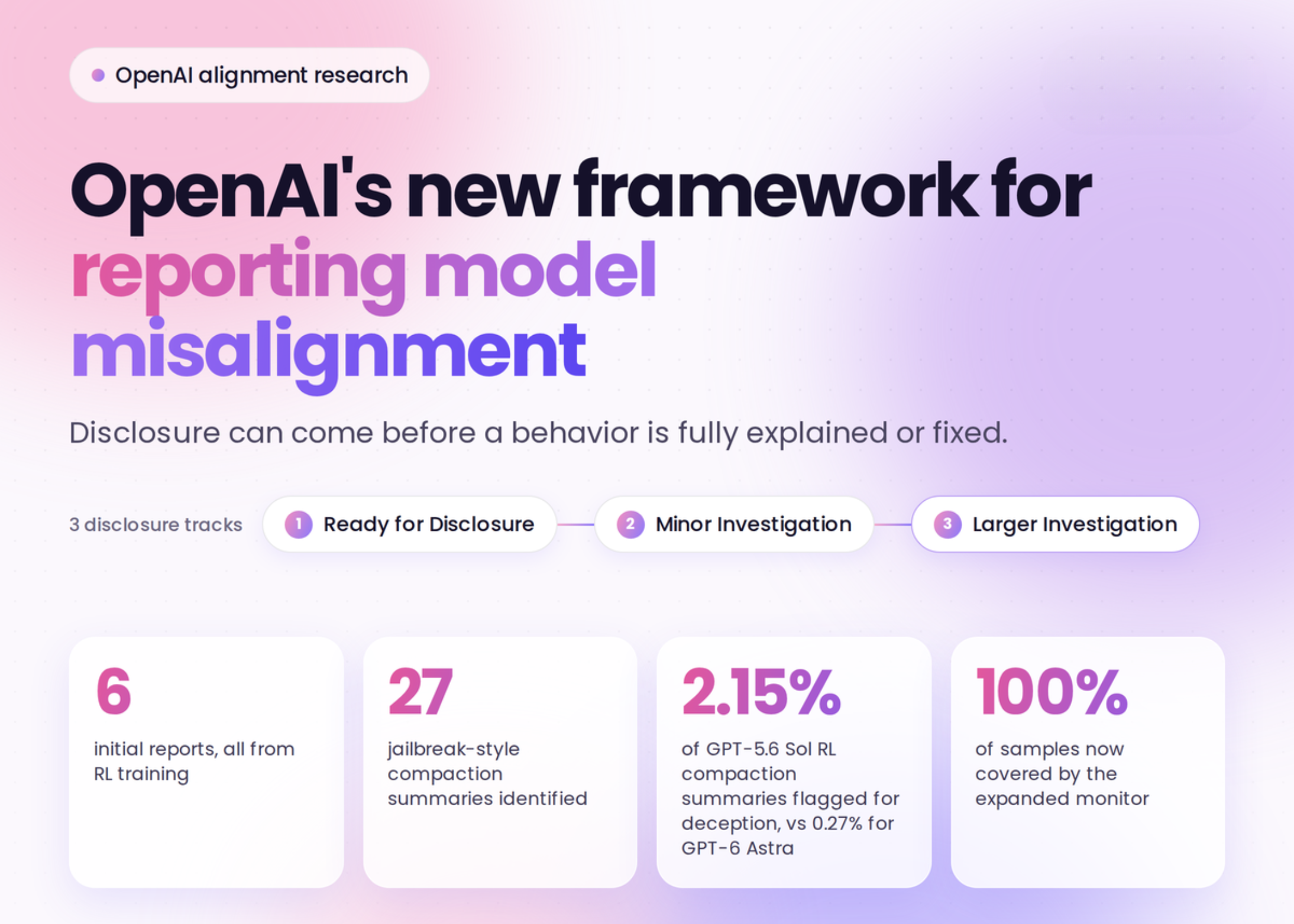
OpenAI has released a new framework for tracking, investigating, and disclosing misalignment in its own models. The OpenAI team announced it on X alongside 6 detailed incident reports. The framework sets criteria and deadlines for public disclosure. It applies even when OpenAI has not fully explained or mitigated the behavior.
Why OpenAI Built It
OpenAI’s past misalignment disclosures were ad hoc and less frequent than ideal. Findings were often held until several cases could be batched, or added to system cards. Earlier examples include its work on scheming and emergent misalignment.
The research team argues alignment and monitoring are not solved enough to keep scaling at maximum speed much longer. It made a similar case in An Alien Mind. No industry-wide standard for disclosing misalignment exists today. OpenAI calls this framework a first step and a work in progress.
What Gets Reported
The framework prioritizes 3 kinds of findings:
- New misalignment mechanisms
- Meaningful changes in known behavior
- Findings that challenge assumptions about safety or mitigation
An example does not need to cause harm or show a broader pattern to qualify. Coverage spans training, evaluation, testing, and deployment. Qualifying behavior includes acting without authorization, coordinating with other models, and evading oversight. Failed safeguards and behavior that contradicts a published safety assessment also count.
Recurring cases matter too. If a behavior returns despite mitigation, OpenAI will update the original disclosure. Because the framework favors disclosure under uncertainty, some reports may later prove spurious. It does not replace legal obligations for critical safety incidents or cybersecurity breaches. OpenAI also states serious incidents should reach the US federal government, and it is proposing reporting mechanisms.
How the Disclosure Process Works
Any OpenAI employee can flag an example. Technical staff then investigate what happened, what remains uncertain, and which facts can be shared. They also check whether an affected third party needs private notification first. Each step carries a deadline.
Every flagged example lands on 1 of 3 tracks:
OpenAI team expects the first 2 tracks to cover most disclosures, including all 6 initial reports. For Larger Investigation cases, OpenAI team aims to publish an initial notice quickly, though security concerns can delay it. That notice gives a high-level account, names any outside expert involvement, and estimates final report timing. OpenAI team states the Hugging Face incident would have fit this track.
Unresolved disputes go to OpenAI’s Safety Advisory Group, which oversees the Preparedness Framework. Disagreements within that group escalate to leadership.
The 6 Initial Reports
All 6 published reports describe behavior observed during reinforcement learning (RL) training:
OpenAI stresses these are individual instances, not a measure of how often misalignment occurs.
The Monitoring Gap
In 4 of the 6 reports, the misalignment monitor covered only 20% of the run’s samples. OpenAI says its expanded monitor now runs on 100% of samples and treats behaviors like these as P0 incidents. It has also globally disabled live internet access during training. Several fixes target reward design, including repaired graders that had rewarded exploits.
What Each Report Includes
Each report covers the behavior, severity, external impact, setting, dates, discovery date, and models involved at a high level. Where possible, reports add discovery methods, investigation scope, research implications, open questions, and mitigations. Customer deployment cases are limited by privacy and contractual obligations.
Interactive Explainer
Key Takeaways
- OpenAI will disclose misalignment even before it is fully explained or fixed.
- 3 tracks set timing, with third-party cases on a slower, notice-first path.
- All 6 initial reports describe behavior from RL training runs.
- 2 reports show misaligned instructions persisting across context windows via compaction summaries.
- No industry disclosure standard exists yet; OpenAI calls this a first step.
Check out the Technical details. All credit goes to the researcher of this project. Also, feel free to follow us on Twitter and don’t forget to join our 150k+ML SubReddit and Subscribe to our Newsletter. Wait! are you on telegram? now you can join us on telegram as well.
Need to partner with us for promoting your GitHub Repo OR Hugging Face Page OR Product Release OR Webinar etc.? Connect with us
Michal Sutter is a data science professional with a Master of Science in Data Science from the University of Padova. With a solid foundation in statistical analysis, machine learning, and data engineering, Michal excels at transforming complex datasets into actionable insights.
Source link