

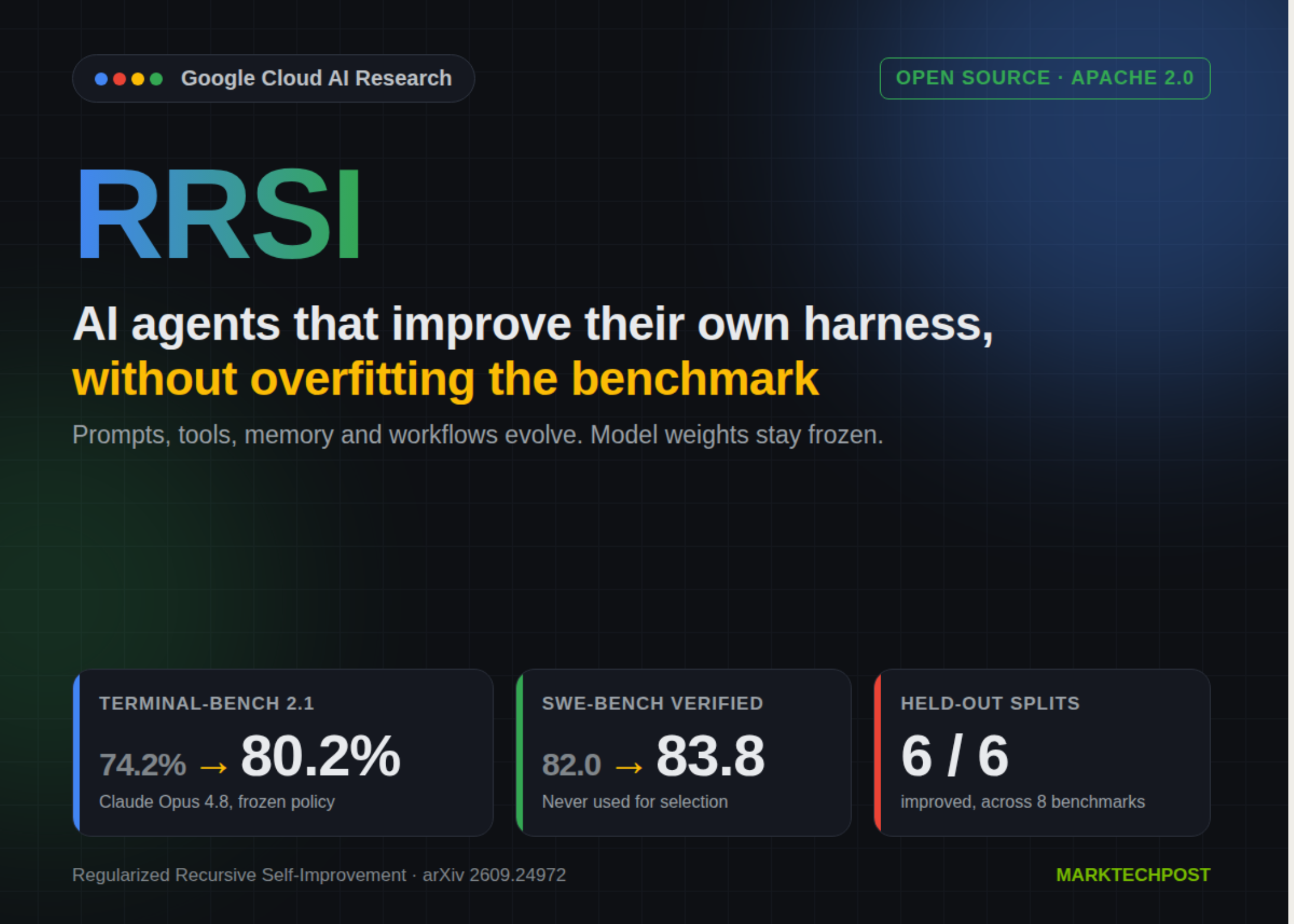
Google Cloud AI Research, with UNC-Chapel Hill, Stanford and Washington University in St. Louis, has released RRSI (Regularized Recursive Self-Improvement). It lets an LLM agent rewrite its own harness: prompts, tools, memory, control flow and sub-agents. Model weights never change. RRSI constrains the improvement loop itself, so gains hold on benchmarks the agent never optimized against.
Deployable? Yes, as a research framework. The code is Apache 2.0, needs Python 3.10+, and accepts any LiteLLM model string. Defaults assume Claude Opus 4.8 on Vertex AI.
Why Self-Improving Harnesses Overfit
Harness evolution loops propose edits, score them on a fixed evolve set and keep the winner. The same tasks are reused every round, so the loop can memorize them. The RRSI research names 3 failure modes: benchmark-specific fitting, noise chasing and complexity accumulation. Each one widens the gap between evolve-set scores and real transfer.
How RRSI Works
RRSI keeps every harness component editable. It regularizes how the search moves instead.
Proposal side
- Annealed edit budget: a cosine schedule lets early rounds bundle several edits. Late rounds allow a single attributable change.
- Evidence-aware credit: each candidate is logged with its component, hypothesis, diff, score change and cost change. The proposer reads this ledger, so falsified ideas are not retried.
- Structured exploration: when progress stalls inside the noise band, budget shifts to components the run never touched.
Selection side
- Leakage critic: rejects task names, entities, answers or benchmark-specific logic before any scoring.
- Noise-adjusted floor: gains must clear the variance measured on the unchanged base harness.
- Cost rule: extra inference tokens must be paid for by measured gain.
- Pruning: components that stop producing gains become deletion targets.
The research team frame these as analogies to classic regularizers. The edit budget maps to L0, pruning to Lasso (L1) and the cost rule to Ridge (L2).
Results Across 8 Benchmarks
All 6 held-out splits improved. With Gemini 3.5 Flash as the policy, Terminal-Bench 2.1 rose from 64.6 to 78.7. SWE-bench Verified rose from 76.8 to 79.0.
The harness is also lighter. On the agentic workspace instance, RRSI uses 2.42M policy tokens per trial. Unregularized evolution uses 3.80M. The abstract reports this as 30% fewer; the project page says 36%.
RRSI vs Closest Competitors
Scores come from Table 1 of the RRSI research paper. All methods share the same starting harness, policy, evolve split and candidate budget.
*Per the RRSI research team. OOD average is the mean of JobBench, GDPval and APEX-Agents, computed from Table 1.
Meta-Harness leads on the Harvey LAB evolve split. RRSI has the smallest evolve gain but the only OOD average more than 1 point above H0.
Interactive Explainer
How RRSI Regularizes Agent Self-Improvement
The model stays frozen. The harness (prompts, tools, memory, control flow) evolves, but every edit must pass the regularizers.
1. Run a round
2. Edit budget
3. Acceptance gate
4. Results
Pick a candidate edit, then press Run. Watch where RRSI stops it.
Generic tool fix
Hardcoded task name
Gain inside noise
Token-hungry gain
Stale component
▶ Run
ProposerReads full edit ledger, shrinking edit budget
Leakage criticScreens diff before scoring
EvaluateRun on evolve set
GateNoise floor + cost rule
Harness Ht+1Accepted, then pruning check
Candidates are illustrative. The rules they hit are the ones described in the RRSI paper.
// edit ledger: component | hypothesis | Δscore | Δcost | verdict
All 8 benchmarks
vs prior methods
Token cost
Getting Started
pip install -e “.[dev]”
python3 rrsi.py –domain coding baseline
python3 rrsi.py –domain coding run
Each round drafts 2 candidates in separate git worktrees, screens them, evaluates both and fast-forwards the branch to the winner. The coding instance also needs Docker and harbor. New domains plug in through a single adapter module.
Key Takeaways
- RRSI evolves prompts, tools, memory and workflows while model weights stay frozen.
- A leakage critic, noise floor, cost rule and pruning decide which edits stick.
- Terminal-Bench 2.1 rose from 74.2% to 80.2% with Claude Opus 4.8.
- SWE-bench Verified, never used for selection, rose from 82.0% to 83.8%.
- Apache 2.0 code on GitHub; research-grade, not an official Google product.
Check out the Paper, Codes and Technical details. All credit goes to the researcher of this project. Also, feel free to follow us on Twitter and don’t forget to join our 150k+ML SubReddit and Subscribe to our Newsletter. Wait! are you on telegram? now you can join us on telegram as well.
Need to partner with us for promoting your GitHub Repo OR Hugging Face Page OR Product Release OR Webinar etc.? Connect with us
Asif Razzaq is the CEO of Marktechpost AI Media Inc.. As a visionary entrepreneur and engineer, Asif is committed to harnessing the potential of Artificial Intelligence for social good. His most recent endeavor is the launch of an Artificial Intelligence Media Platform, Marktechpost, which stands out for its in-depth coverage of machine learning and deep learning news that is both technically sound and easily understandable by a wide audience. The platform boasts of over 2 million monthly views, illustrating its popularity among audiences.
Source link