

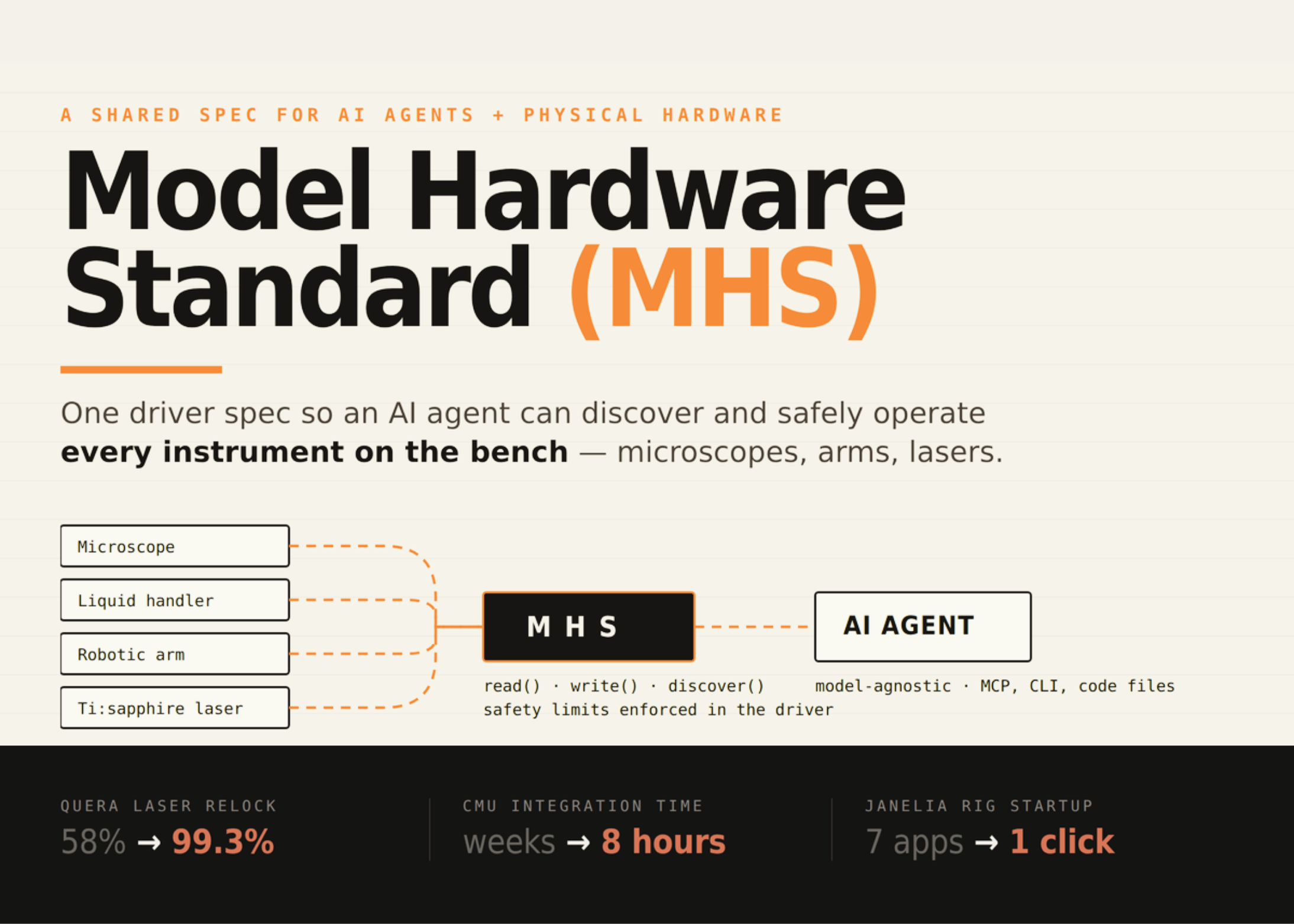
Anthropic has opened a research preview of the Model Hardware Standard (MHS), a shared specification that lets AI agents discover and operate physical devices. The problem it targets is plumbing. A lab bench or factory cell is assembled from vendors that never planned to interoperate, so every instrument ships its own interface and specialists hand-write bespoke translators between each pair. According to Anthropic team, the setup normally takes weeks to months, and that MHS cuts it to hours or minutes.
The Integration Tax
Each instrument ships its own programming interface, so specialists hand-write bespoke translators between every pair. Even once wired together, there is no common way for devices to hand state to an agent or be operated safely by one. Anthropic says setup typically runs weeks to months; MHS reduces it to hours or minutes.
How it works
MHS standardizes the driver — the layer between an OS and a device. It exposes a small primitive set: read (get temperature), write (set temperature), plus discovery, so devices and agents find each other across a network without a translator in between.
It also carries knowledge code alone does not encode — the weight of a robot arm, for instance. Driver tags let a user write that in natural language, or have an agent interview them about the setup. The driver compiles those tags into a reference file: what a device measures, what can be adjusted, which safety limits are enforced.
Control runs through three mechanisms: the Model Context Protocol, a CLI, and code files. MHS is model-agnostic — any agent harness can reach it via standard protocols.
What partners measured
Genentech automated the BCA protein assay across a liquid handler, robotic arm, and plate reader. Claude ran trial transfers of dyed liquid, read absorbance, scored itself against an expert’s plate using RMSE, and converged on ~140 µL/s for water (0.016 RMSE) and 10 µL/s for viscous BSA (0.181 RMSE) — parameters its automation experts confirmed as reasonable.
QuEra Computing is the sharpest number. A bespoke laser-relock script, built over months by a four-person team, worked about 58% of the time at ~150 seconds per attempt. Handed the same problem through MHS, a four-role agent loop ran unattended overnight and produced a deterministic Python script that recovered the lock 695 times out of 700 — 99.3%, hardest cases in 10–14 seconds against 5–10 minutes for a human. Claude also cut the servo’s residual error from a specialist’s 15.7 mV to 1.55 mV; over a 19-hour run its tune never lost lock, while the expert tune unlocked about 1.6 times an hour (QuEra blog).
Carnegie Mellon ran dose-response experiments roughly three times faster, orchestrating a liquid handler, plate reader, robotic arm, and cameras across three computers with incompatible interfaces — one with no programmatic interface at all. Driver-writing through to a completed curve, including an autonomous rerun after the agent rejected an R² < 0.9 fit, took about eight hours against the several weeks a vendor setup takes. Six induced fault conditions were all blocked before any device moved.
At the University of Washington, a PhD student in the Baker and Pinglay labs connected six instruments in under a week, driver-writing included. Tetsuwan Scientific paired MHS with its ResearchOS platform for qPCR pollution profiling. At Janelia, one microscopy rig went from seven programs launched in a fixed order to a single dashboard click.
Key Takeaways
- A shared driver spec letting AI agents discover and operate any device with a programmable interface.
- Integration drops from weeks to hours: CMU hit a finished dose-response curve in eight.
- QuEra’s laser relock: 58% at ~150s, to 99.3% across 700 trials, as a deterministic script.
- Model-agnostic and MCP-compatible; safety limits live in the driver, not the prompt.
- Still gated, and still needs supervision — Claude’s physical reasoning has real gaps.
Check out the full announcement and apply for the preview. Also, feel free to follow us on Twitter and don’t forget to join our 150k+ML SubReddit and Subscribe to our Newsletter. Wait! are you on telegram? now you can join us on telegram as well.
Need to partner with us for promoting your GitHub Repo OR Hugging Face Page OR Product Release OR Webinar etc.? Connect with us
Asif Razzaq is the CEO of Marktechpost Media Inc.. As a visionary entrepreneur and engineer, Asif is committed to harnessing the potential of Artificial Intelligence for social good. His most recent endeavor is the launch of an Artificial Intelligence Media Platform, Marktechpost, which stands out for its in-depth coverage of machine learning and deep learning news that is both technically sound and easily understandable by a wide audience. The platform boasts of over 2 million monthly views, illustrating its popularity among audiences.
Source link