


Close Menu
InvesthenaInvesthena
    What's Hot

    Frozen Savings Meet Bitcoin’s Explosive Rally

    September 13, 2026

    Lifesaving Lincoln Laboratory device wins 2026 Excellence in Technology Transfer Award | MIT News

    September 13, 2026

    Your TFSA Owns 3 ETFs: It May Still Be 1 Big Technology Bet

    September 13, 2026
    InvesthenaInvesthena
    • Business
    • Economy
    • Investing
    • Stocks
    • Best Savings Accounts
    InvesthenaInvesthena
    Home»Investing»Scan reveals 96,000 fake-address outputs clogging Bitcoin’s unspent database
    Investing

    Scan reveals 96,000 fake-address outputs clogging Bitcoin’s unspent database

    September 4, 2026
    Scan reveals 96,000 fake-address outputs clogging Bitcoin’s unspent database
    Share
    Facebook Twitter LinkedIn Pinterest Email


    Blockchain data company Bitquery published a census on Sept. 2 of four ways text appears in Bitcoin, scanning 965,135 blocks and revealing that the same words can impose very different costs on nodes.

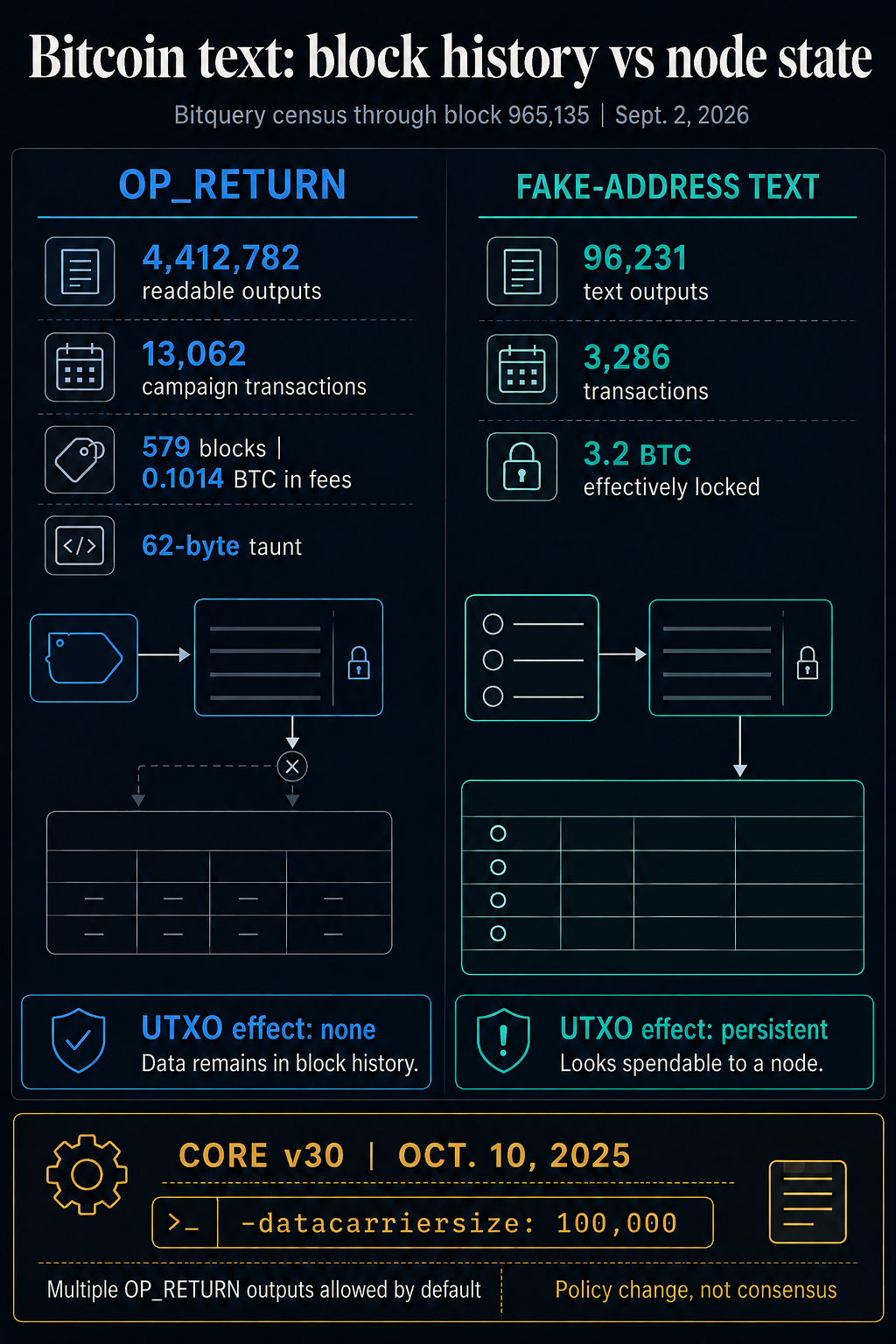
    Its study counted 13,062 OP_RETURN taunt transactions that added no spendable state, against 96,231 fake-address text outputs that remain in the unspent transaction output set.

    The March 21-26, 2026, campaign named Bitcoin Core developer Luke Dashjr in the same two-sentence taunt. Bitquery counted 13,062 transactions from 13,062 sending addresses across 579 blocks, with 0.1014 BTC paid in aggregate fees. The chain records the text, timing, inputs, and fees, but it does not identify the payer, author, or motive.

    Across the broader scan, Bitquery classified 4,412,782 OP_RETURN outputs as readable text. Their node cost differs from fake-address text because Bitcoin treats the two output types differently after confirmation.

    Nodes do not need to retain an OP_RETURN output in the UTXO database used to check whether coins can be spent, although its data remains in Bitcoin’s block history. The Bitcoin developer guide describes this null-data construction as preferable to methods that create outputs which look spendable and burden the UTXO set.

    Fake-address text places readable bytes where an address hash would normally go. A node sees an apparently spendable output, while the embedded text has no known corresponding private key.

    Bitquery classified 96,231 such outputs across 3,286 transactions and estimated that they hold about 3.2 BTC that is effectively unspendable. Those outputs persist as current node state unless they are spent.
    The Daily Brief

    The signal, before the noise.

    Start your day with the crypto stories moving markets, decoded by CryptoSlate’s editors.

    One email. Everything that matters.

    Free to join. Unsubscribe any time.

    Whoops, looks like there was a problem. Please try again.

    You’re on the list. Your next Daily Brief is on its way.

    Comparison of OP_RETURN and fake-address Bitcoin text, showing OP_RETURN adds no UTXO entries while 96,231 fake-address outputs persist in node state.

    Bitcoin Core 30.0, released in October 2025, made larger OP_RETURN transactions easier to relay under its default policy. The release notes raised the default -datacarriersize setting to 100,000 and allowed multiple OP_RETURN outputs under an aggregate limit for relay and mining.

    These standardness choices did not change the consensus rules that determine whether a block is valid.

    Bitquery found that messages longer than the former 80-byte payload ceiling appeared only a few dozen times in most months before v30 and rose into the thousands by February 2026. Easier default propagation offers one mechanism for that rise, but the observational sequence does not show that v30 alone caused it.

    The March taunt disclosed text is 62 ASCII bytes, which already fit below the former ceiling. The campaign measures the low cost of repeating OP_RETURN text after v30.

    Bitquery also lacked coinbase fields for 191,427 historical blocks and did not count witness inscriptions. The study therefore compares the state consequences of four measured channels rather than tallying every piece of text embedded in Bitcoin.

    Within that scope, OP_RETURN expands block history without bloating the UTXO set, while fake-address text creates the lasting node-state burden.


    Source link

    Previous ArticleRemixpoint Sells $5.5M in Altcoins to Focus on Bitcoin
    Next Article A Top TSX Dividend Stock to Buy on Pullbacks

    Related Posts

    Frozen Savings Meet Bitcoin’s Explosive Rally

    September 13, 2026

    Revolut Exposed Passports and Bitcoin Records After Fake Government Request: Report

    September 13, 2026

    Nasdaq market surveillance cannot settle tokenized rules

    September 12, 2026

      Subscribe to Updates

      Subscribe to our newsletter for early access to new products, exclusive deals, and exciting updates. Don't miss out! Our subscribers are always the first to hear about limited-time offers and new arrivals. Plus, you'll get sneak peeks and bonus content that adds value to your experience.

      By opting in you agree to receive emails from us and our affiliates. Your information is secure and your privacy is protected.

      Top Posts

      Frozen Savings Meet Bitcoin’s Explosive Rally

      September 13, 2026

      Revolut Exposed Passports and Bitcoin Records After Fake Government Request: Report

      September 13, 2026

      Nasdaq market surveillance cannot settle tokenized rules

      September 12, 2026

      Investhena is a digital news blog covering the latest updates in crypto, global economy, and investing. We focus on clear, timely insights to help readers stay informed and understand market trends without unnecessary complexity.

      Letest News

      Frozen Savings Meet Bitcoin’s Explosive Rally

      September 13, 2026

      Lifesaving Lincoln Laboratory device wins 2026 Excellence in Technology Transfer Award | MIT News

      September 13, 2026
      LEGAL INFORMATION
      • Contact us
      • Terms & Conditions
      • Privacy Policy
      Copyright © 2026 investhena.com | All Rights Reserved

      Type above and press Enter to search. Press Esc to cancel.